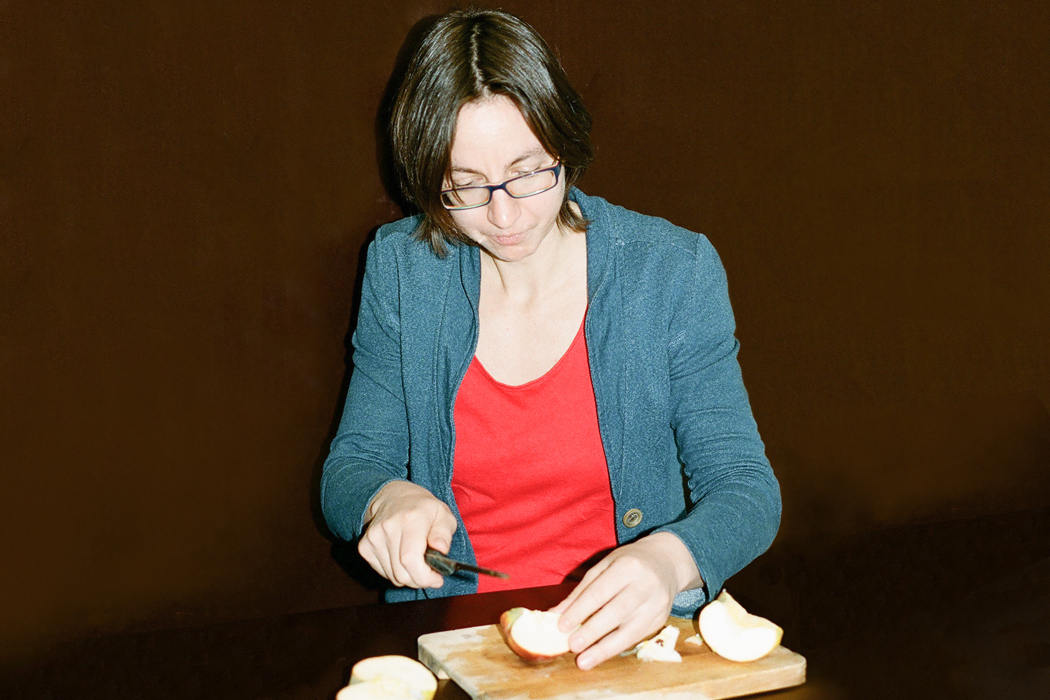
Caren Ohrhallinger is an architect who lives in Vienna – and she
is one of those people who change things. For instance, the way we will
live in the future.
Caren Orhallinger is pretty laid-back about awards.
Antje Mayer: You were the 2012 Austrian of the Year. I’d also like to be that one day. How did that come about?
Caren Ohrhallinger: You’ll be surprised! (laughs) It was then an initiative of the daily newspaper Die Presse, which presented an annual award to outstanding achievements in the categories Creative Industries, Research, Humanitarian Engagement, Cultural Management, and Economy. We were nominated by the newspaper editors and a distinguished jury, but also the readers voted for our architecture office “nonconform architektur vor ort” in the Creative Industries category. We were thrilled. Two years before the weekly magazine NEWS had already selected us as one of the top ten most innovative enterprises in Vienna.
The decoration ceremonies of today – society obviously needs them!
Yes, apparently these sorts of rituals are important. We also noticed that such awards are appreciated; many of our clients asked us about it. It opens the door to recognition outside of your own trade. But we’re pretty laid-back about such awards. You cannot plan something like this, but naturally it makes us happy.
Caren Ohrhallinger and I are sitting in the pub Einfahrt on the Karmelitermarkt in Vienna’s 2nd
district. Caren orders a beer, me too. We smoke a cigarette together. I
remember reading about this place on www.diefruehstueckerinnen.at: “Not really pretty, but cozy. A bit like a favorite chair, which you can never part with.” That sort of hits the point, I think.
And how does one become a happy architect?
Every profession has its highs and lows. When we were really in a
valley, we spoke with a very competent business consultant for creative
industries and refined our profile together with him. We got rid of a
lot of unnecessary weight and concentrated on the things that interested
us and made us happy, and, above all, where we could use our strengths.
This combination breeds happiness. In the meanwhile, we are now four
partners and work with 15 employees on incredibly cool projects. Our
office is splitting at the seams.
But you’re not always so relaxed. You swore in a manifesto of sorts that you never want to build single-family homes again! Why were you so annoyed?
We weren’t annoyed – “we” meaning me and my partners Roland Gruber and
Peter Nageler – all of us come from this type of housing. But at the
time we were drudging our way from one tedious single-family home job to
the next. At some point, it became clear that this wasn’t going to make
us happy. We simply had to take a stance and end it.
I always thought that business consultants were overpaid and not practice-oriented.
No, he was really good – Eric Pöttschacher is his name. And he himself
comes from the creative scene. He understood our language and problems
very well. He helped us to put three – at the time totally hypothetical
and seemingly absurd – scenarios on the table, which united our
strengths and where we were sure that they would make us happy. One of
them was participative planning, which now bears the name “vor ort
ideenwerkstatt” (on-site idea workshop) and is super successful.
What is that?
In short: When a municipality is faced with a public building project –
it could be the design of a public space, the renovation of a school,
the question of where to build the new town hall – or more comprehensive
tasks like the development of complete residential quarters or an urban
planning model, we come upon invitation of the mayor for three days and
work together with the citizens on site. The users are intensively
involved in the process. Their needs and ideas find their way into the
concept developed on site, which then forms the basis of further
planning or, for example, a competition tender. Imagine it as a
well-organized, extremely fun and exciting three-day idea festival where
many people work together with us.
Daring – and that was in 2006. Participative projects were far from being so “in” as they are today…
Today, participation is almost a requirement – at least from the
municipalities – but no big illusions, please! Citizens quite often need
to be motivated. Decision-makers recognize that room for participation
and acceptance are vital factors. But they also have to learn that
participation involves a lot of work and has to be meant sincerely. It
can’t just be an alibi action, and most of all they have to be open to
the results. Asking that from the mayor is not all that easy, but it
keeps getting better. (laughs)
It is not that it doesn’t work; it works differently. Direct
participation needs a manageable and clearly defined structure and a
unifying identifiable element like a small or middle-sized municipality.
These manageable units can also be found in Vienna – like a street or a
neighborhood. People need the feeling that this is my living room, that
this part of the city belongs a bit to me. Then the inhabitants speak
in detail and emotionally, contribute constructively, and in the end
also accept the results. But participation is always a process and a
negotiation of different interests as well; the larger and unmanageable
the number of protagonists, the more of a challenge it becomes.
Is something changing in Vienna?
Vienna is focusing on its periphery, for example the 21st and 22nd
districts. Vienna knows – take Seestadt Aspern as an example – that you
cannot design the ground floor with 2.1-meter-high garbage and storage
rooms, they’re stillbirths. Rather they should open up to the urban
space with workshops, gastronomy, offices, shops, and kindergartens –
and also homes – and thus other room heights are also permitted. We need
urban habitats, exactly like those we love and treasure in the model of
the Gründerzeit city. Without a functional mix – as it has been
practiced in Vienna since the post-war years – urban quarters degenerate
into deserted dormitory and office towns.
I find 2.5-meter room heights oppressive…
Room height is a quality. I am happy to live in an old building. Gründerzeit flats are ingeniously designed. I’ll make a sketch.
Caren Ohrhallinger pulls a pen and a piece of paper from her bag and begins drawing…
Even though they were built more than 100 years ago and nobody knew
how we would be living today, they can accommodate every function. These
flats can function as a studio, office, apartment, doctor’s practice,
store, workshop, or kindergarten. Why? Because all of this is possible
with a room height typically over 3 to 3.5 meters. When there’s only 2.5
meters of airspace you can only live there. The load-bearing walls of
the Gründerzeit houses are positioned in such a way that entire
sequences of rooms can be interconnected, namely longitudinally, so the
floor plan can be changed as desired. This isn’t possible in most newly
built flats as the transverse walls are built as part of the supporting
structure.
Very interesting. The old buildings are more than a hundred years old and still work today. How long do newly built houses last?
25 years, generally speaking. In this timeframe the project has to
usually be paid off for the investor. Absolutely no attention is paid to
the costs for such a short lifespan. It’s crazy when you think about
the aspect of sustainability. In our research projects we have developed
a building system with a functionally open floor plan, no load-bearing
walls, and collectors for the sanitary installations, which guarantees
flexible and thereby sustainable usage: the new town house. Everyone
knows that the coolest workshops, apartments, and studios are in lofts.
For the classic property developer, however, such a functionally open
building is still undiscovered territory. That’s why we are currently
founding our own cooperative with fellow colleagues, so we can act more
independently.
A main passion for me is public space. It has less to do with design is the classic sense, rather it is about fair distribution.
What makes you sad?
I’m not sad, actually most of the time I am quite satisfied. What
frustrates me sometimes is the human incapacity for logical decisions.
For example: In the run-up to the elections in a municipality, when no
decision can be made on a matter, which was co-developed and approved by
all political fractions, simply because of election tactics. That can
really piss me off.
What do you love about Vienna?
Vienna has a nice size: You can quickly reach green areas outside the
city, yet it also has neighborhoods with their own unique character; it
is sort of like a village. When you walk around the city, guaranteed you
will meet someone you know and stop to chat. That’s what I love about
the 2nd district where I live. But I wouldn’t want to live
just anywhere in Vienna – the combination of two of Vienna’s largest
green spaces, the varied urban structure, the infrastructure in close
walking distance, and the good public transportation connections
distinguish the quality of my district. I wouldn’t want to do without
any of the four points; but there are enough areas in Vienna that don’t
have this.
What have you always wanted to do?
A long, non-motorized trip – I just read the book by Bill Bryson A Walk in the Woods. Things
like this inspire me, but it doesn’t have to be Appalachian Trail.
Earlier I wanted to hike through Scotland. Perhaps it would also be nice
to bike all across Europe. Just that it would be too boring, and my
partner doesn’t want to. Maybe my daughter will travel with me through
the country in a few years.